# The ultimate guide to AEO: How to get ChatGPT to recommend your product | Ethan Smith (Graphite)
Table of Contents
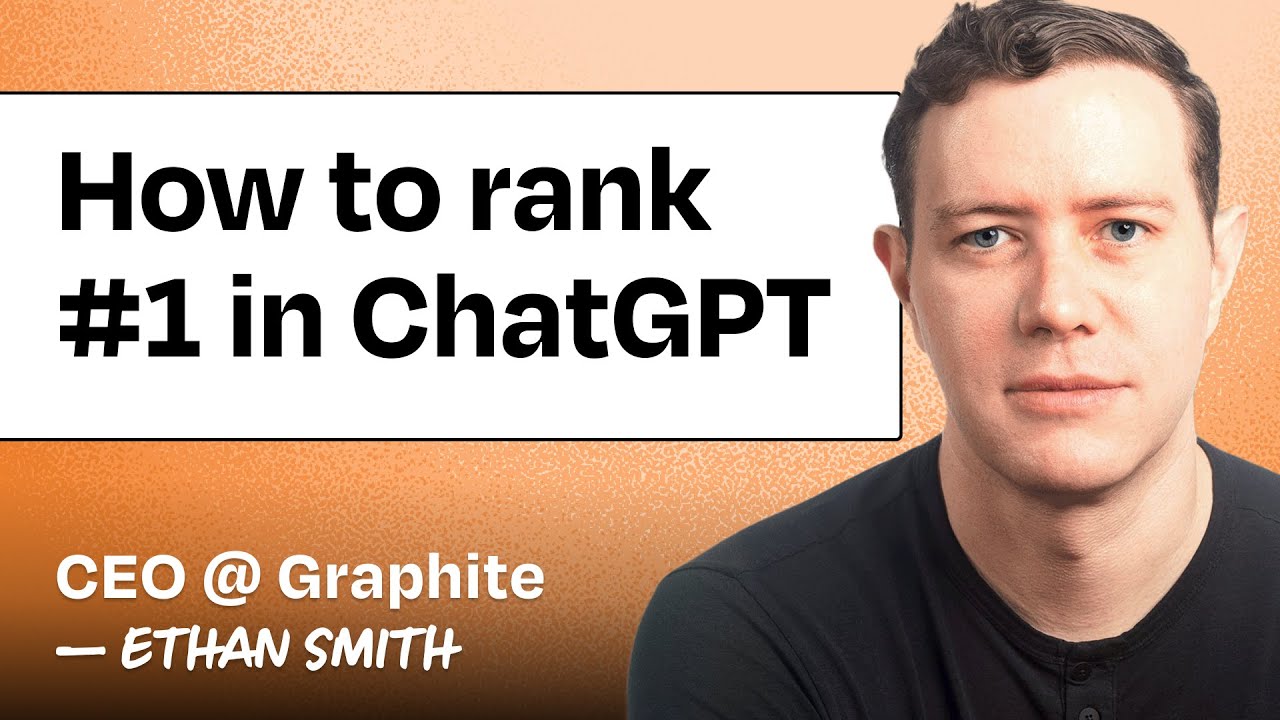
These notes are based on the YouTube video by Lenny’s Podcast
Key Takeaways
- AEO (Answer Engine Optimization) ≈ SEO for LLMs – Optimizing content so that large language models (ChatGPT, Claude, Gemini, Perplexity) cite your product in their answers.
- LLM traffic can convert substantially better than Google search – Anecdotal reports (e.g., Webflow) suggest lifts of up to 6× in conversion rate for LLM‑derived visits, but the exact multiplier varies by brand and should be validated with your own experiments.
- Winning AEO is often faster for early‑stage companies – A single high‑quality citation (Reddit comment, YouTube video, blog mention) can surface your brand within a day for low‑competition, long‑tail queries, though head‑type queries still benefit from citation volume and authority.
- Three core levers:
- On‑site (traditional SEO) – Build topic‑focused landing pages that answer both the primary question and its follow‑ups.
- Off‑site citation strategy – Earn mentions across YouTube/Vimeo (see how to build iOS apps with Claude Code in the EASIEST way), Reddit, Q&A sites, affiliate media (e.g., Dot‑Dash/Meredith).
- Experimentation & tracking – Use “answer tracking” (the AEO analogue of keyword tracking) and run controlled experiments to validate tactics.
- Head vs. Tail in LLM answers –
- Head: The model favors the source with the most citations; you need many mentions rather than a single top rank.
- Tail: LLM prompts are longer (typically 20‑30 words) and generate a far larger set of specific, long‑tail questions that didn’t exist in classic search.
- Reddit is one of the most influential citation sources – Authentic, community‑vetted comments rank highly; spammy bots are quickly banned.
- AI‑generated content alone does not work – Purely automated articles perform poorly in both Google and LLM results; AI‑assisted (human‑in‑the‑loop) content is the sweet spot.
- Help‑center optimization is a hidden AEO win – Frequently asked support questions become citation material; structure help articles in sub‑directories, cross‑link, and cover obscure “tail” use‑cases.
Important Concepts Explained
1. What is AEO / GEO?
- AEO (Answer Engine Optimization) – The practice of shaping content so that LLMs surface your brand as a citation in their generated answers.
- GEO (Generative Engine Optimization) – A broader term that includes non‑answer outputs (images, videos). Ethan prefers “Answer Engine Optimization” because the focus is on textual answers.
- Bottom line: Both refer to the same optimization goal: being the source that LLMs pull from.
2. How LLMs Generate Answers (RAG)
- Core model – Predicts the next token based on massive pre‑training (Common Crawl, etc.).
- RAG (Retrieval‑Augmented Generation) – After the core model decides to answer, it runs a live search over recent documents, retrieves citations, and then synthesizes a response.
- AEO impact – You can’t change the core model, but you can influence the RAG layer by ensuring your content appears in the retrieval set (i.e., get cited).
3. Head vs. Tail Dynamics
| Aspect | Traditional SEO (Google) | AEO (LLMs) |
|---|---|---|
| Winning signal | Rank #1 in blue‑link results | Appear in the most citations; the model favours the source with the highest mention count. |
| Content length | ~6 words for the query | ~20‑30 words, allowing richer, multi‑sentence prompts. |
| Long‑tail | Limited; many niche queries never exist. | Vast; LLMs comfortably handle highly specific, never‑before‑asked questions. |
| Time to win | Months–years (domain authority). | Days for low‑competition tails; head queries still need citation volume. |
4. Citation Sources & Their Roles
| Source | Why it matters | Typical strategy |
|---|---|---|
| YouTube / Vimeo | Video content is indexed as a citation; low competition for niche B2B topics. Tip: Leverage Claude Code’s new native skills to make your videos more discoverable. | Produce concise, SEO‑optimized videos answering specific questions. |
| Community‑vetted, high‑trust signals; heavily weighted in RAG. | Participate authentically: create a profile, disclose affiliation, provide useful answers. | |
| Affiliate / Media Networks (e.g., Dot‑Dash, Meredith) | Massive authority sites that appear in many citations. | Secure paid mentions or guest posts where feasible. |
| Blogs / Quora / Other UGC | Adds breadth to citation pool. | Guest write, answer questions, or encourage user‑generated content. |
5. Answer Tracking (AEO Analytics)
- What it measures: Share‑of‑voice across LLMs, average rank in answers, frequency of appearance.
- How to set it up:
- Choose a tool (many keyword trackers can be repurposed; there are dozens of emerging AEO‑specific solutions).
- Define the set of target questions.
- Query multiple LLM surfaces (ChatGPT, Claude, Gemini, Perplexity) repeatedly to capture variance.
- Record citation presence, rank, and click‑throughs.
🔗 See Also: The ultimate guide to AEO: How to get ChatGPT to recommend your product
- Interpretation: A rising share‑of‑voice indicates successful citation acquisition; a flat line suggests the need for new off‑site tactics.
6. Experiment Design for AEO
- Select a question pool (e.g., 200 target queries).
- Split into control (no intervention) and test groups (apply a specific tactic: Reddit comment, new video, paid mention, etc.).
- Track baseline answer‑share for both groups over a pre‑defined period (2‑4 weeks).
- Implement the tactic on the test group.
- Measure post‑intervention answer‑share and compare against control.
- Repeat to ensure reproducibility; only scale tactics that consistently lift the metric.
7. Help‑Center Optimization as AEO
- Why it works: LLMs often answer “how‑to” or “does X support Y?” by pulling from product help docs.
- Best practices:
- Host help content on a subdirectory (
example.com/help/...) rather than a subdomain. - Implement robust internal linking between help articles.
- Cover tail use‑cases (e.g., obscure integrations) that competitors may miss.
- Encourage community contributions (e.g., a public forum) to generate additional citations.
- Host help content on a subdirectory (
8. Misconceptions & Industry Noise
- “Google is dying” – False. Search volume remains stable; AI simply adds a new layer on top.
- “All SEO tools are overpriced” – AEO tools appear expensive because the market is nascent; the underlying function (tracking citations) is comparable to classic keyword tracking.
- “AI‑only content will dominate” – Empirical studies show only ~10‑12 % of top results are AI‑generated; pure AI content fails to rank long‑term.
Practical Step‑by‑Step AEO Playbook
-
Identify Target Questions
- Pull paid‑search keywords (your own and competitors’).
- Convert each keyword into a natural‑language question using ChatGPT (
“best website builder” → “What’s the best website builder for a small business?”).
-
Set Up Answer Tracking
- Choose an affordable tracker (many keyword tools can be repurposed).
- Input the question list; schedule regular queries across multiple LLMs.
-
Audit Existing Citations
- Search each question in the LLMs; note which URLs appear as citations.
- Categorize citations (video, Reddit, media, blog, etc.).
-
Create / Optimize On‑Site Content
- Build topic‑focused landing pages that answer the primary question and all plausible follow‑up sub‑questions.
- Use structured data (FAQ schema) to surface sub‑questions directly in search snippets.
-
Launch Off‑Site Citation Campaigns
- YouTube/Vimeo: Publish short, SEO‑optimized videos titled as the exact question.
- Reddit: Join relevant subreddits, disclose affiliation, and answer with genuine value.
- Media/Affiliate: Pitch guest posts or paid mentions to high‑authority outlets.
-
Run Controlled Experiments
- Apply a single tactic to a test subset of questions.
- Monitor answer‑share changes vs. control.
- Iterate only on tactics that show statistically significant lifts.
-
Iterate & Scale
- Double‑down on the few high‑impact pages (the “5 % rule”: ~20 % of pages drive ~80 % of traffic).
- Continuously refresh content to stay relevant for new follow‑up questions.
Summary
Answer Engine Optimization (AEO) is the emerging discipline that adapts classic SEO tactics to the world of large language models. By focusing on citation volume, topic depth, and off‑site mentions (especially Reddit and video platforms), companies can appear in LLM‑generated answers much faster than they could ever rank in traditional search. The channel is already delivering significant conversion lifts for early adopters, and its growth curve suggests it will become a staple traffic source alongside Google.
Success hinges on a data‑driven loop:
- Define the question set → track answer‑share → create on‑site content → earn diverse citations → experiment → repeat.
Early‑stage startups can win quickly by earning a handful of high‑quality citations, while larger B2B or commerce firms should also invest in help‑center optimization to capture the massive long‑tail of specific queries. Pure AI‑generated content is ineffective; the winning formula remains human‑crafted, AI‑assisted content that answers both the primary query and its myriad follow‑ups.
For ongoing insights, follow Ethan Smith on LinkedIn, subscribe to the graphite.io/5percent blog, and contribute any AEO experiments or findings back to the community.