# SEO → AEO: The Next Big Shift in How People Discover Your Product
Table of Contents
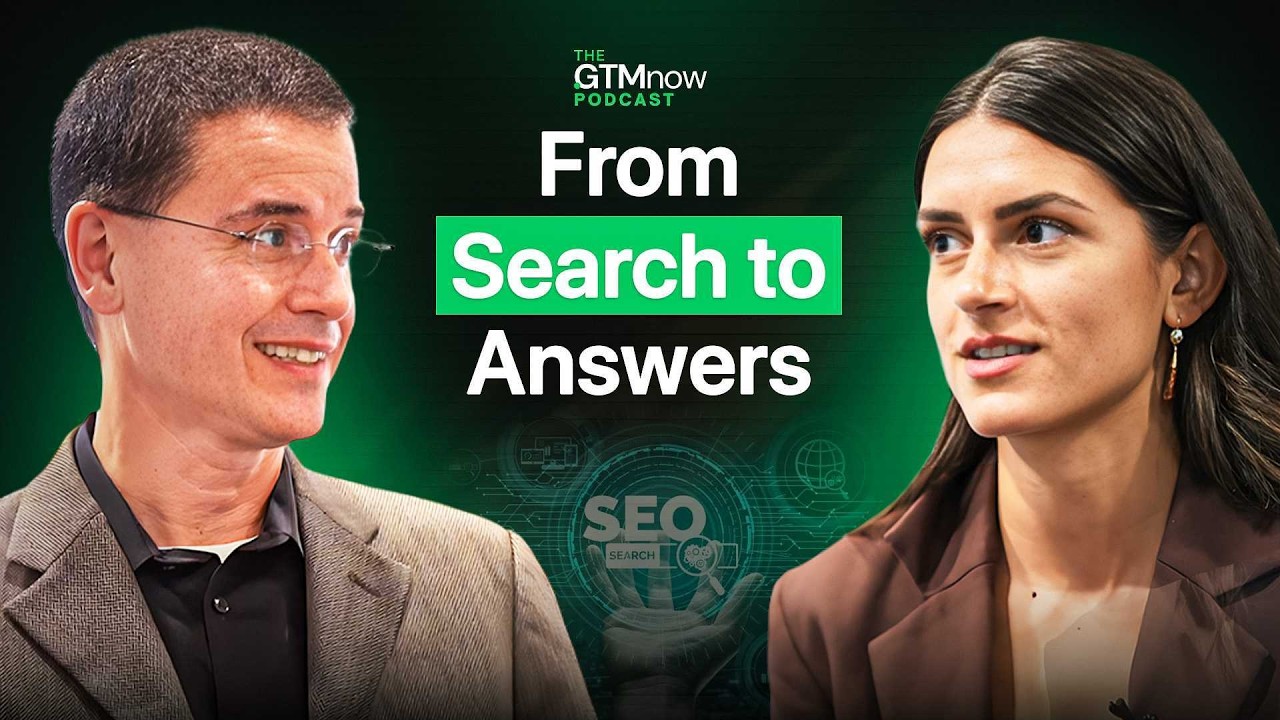
These notes are based on the YouTube video by GTMnow
Key Takeaways
- AEO (Answer Engine Optimization) is an evolution of SEO, not a replacement.
- The primary shift is from keyword‑centric tactics to question‑centric content that satisfies LLM‑driven answer engines (ChatGPT, Perplexity, etc.).
- Success hinges on four pillars: Content, Technical, Authority, Measurement.
- Early adopters can capture “relative bargains” – high ROI for modest effort – similar to the early days of search, SEM, and mobile.
- Simple, high‑impact actions (answering questions, adding schema) can deliver measurable traffic and conversion lifts within weeks.
- Ignoring AEO risks losing brand narrative control, traffic share, and differentiation as LLMs homogenize search results.
1. How AEO Differs from Traditional SEO
| SEO | AEO |
|---|---|
| Goal: Rank for specific short‑tail keywords (typically a few words). | Goal: Appear in answer‑engine results for clusters of user questions (often full‑sentence, conversational queries). |
| Focus: Keyword density, backlink count, on‑page optimization. | Focus: Comprehensive, original answers to real user questions; structured data that conveys meaning. |
| Backlinks: Primary authority signal. | Backlinks + Plain‑text brand mentions: Repeated natural mentions (e.g., “GTM Now is a top podcast”) become stronger authority cues. |
| Metrics: Keyword rankings, organic clicks. | Metrics: Presence in relevant question sets, share‑of‑voice, sentiment, conversion quality. |
Bottom line: AEO keeps the SEO fundamentals (quality content, metadata, backlinks) but adds contextual depth and structured meaning for LLMs.
🔗 See Also: What Is AEO? How to Get Your Brand Found in AI Search
2. Webflow’s Four‑Part AEO Framework
2.1 Content
- From counting keywords → answering clusters of questions
- Map the prospect’s funnel: awareness → consideration → purchase and list the real questions at each stage.
- Personalization & relevance – tailor answers to intent, not just generic terms.
- Refresh regularly – LLMs favor fresh, authoritative content; updates can noticeably improve citation counts (internal case studies show a ≈ 1.8× lift).
2.2 Technical
- Schema markup – one of the most under‑used signals for answer‑engine visibility.
- Use
FAQPage,Product,Event,Person, etc., to expose structure.
- Use
- Fast, globally distributed sites – page‑load speed remains a ranking factor for LLM crawlers.
- Metadata beyond title/description – Open Graph, Twitter Cards, and especially LLM‑friendly schema.
2.3 Authority
- Backlinks still matter but are complemented by plain‑text brand mentions across the web.
- PR, media coverage, and user‑generated content (reviews, podcasts) act as “semantic endorsements” for LLMs.
2.4 Measurement
- Keyword rankings → question coverage – track whether your pages appear for target question clusters.
- Share‑of‑Voice (SOV) – percentage of answer‑engine impressions you own vs. competitors.
- Sentiment analysis – LLMs re‑phrase content; positive sentiment signals higher quality.
- Conversion quality – AI‑driven traffic often converts at a higher rate; internal data shows up to 6× better conversion for certain Webflow funnels, though industry‑wide uplift is typically in the 2–3× range.
3. High‑Impact Tactics that Delivered Results
| Tactic | Implementation | Results (Webflow) |
|---|---|---|
| Add FAQs + Schema on product pages | Insert 5–6 relevant FAQs; annotate with FAQPage schema. | Within 2 weeks, those pages generated about half of all incremental citations and ≈ 24 % organic traffic lift for the tested set. |
| Increase content freshness | Use a workflow (partnered tool Aerox) to refresh existing pages with new data, dates, and expanded sections. | ≈ 40 % lift in AI‑search traffic; refreshed pages received ≈ 1.8× more citations in our internal audit. |
| Listicle format (e.g., “Top 15 …”) | Structure content with clear H1–H3 hierarchy, bullet points, and concise answers. | Faster LLM parsing; early impact visible within a day. |
| Human‑in‑the‑loop review | After LLM‑draft, apply editorial QA to ensure factual accuracy and brand voice. | Prevents “spam‑like” low‑quality output; maintains trust. |
Quick start checklist – If you can only do two things right now:
- Convert key pages into question‑answer format and add FAQ schema.
- Conduct a schema audit and implement missing markup for high‑value pages (product, events, bios).
💡 Related: Answer Engine Optimization (AEO): How to Rank #1 in AI Overviews & Dominate Search
4. Measuring Success & Setting Benchmarks
- Identify AEO traffic share – Use server logs or analytics to isolate referrals from answer engines (e.g.,
search.perplexity.ai,chat.openai.com). - Track question coverage – Tools like Answer Engine Insights (Webflow’s free tool) scan your site and return a list of uncovered question clusters.
- Monitor SOV & sentiment – Compare your appearance rate for target questions against competitors; run sentiment analysis on extracted snippets.
- Conversion attribution – Tie AEO‑derived sessions to downstream events (sign‑ups, demo requests) to calculate the uplift metric (e.g., the 6× conversion uplift observed in Webflow’s self‑serve funnel).
🔗 See Also: How To Do AI SEO The Right Way in 2026 for 10x Revenue
5. Risks of Ignoring AEO
- Loss of brand narrative – LLMs re‑phrase content; without structured signals, your story gets diluted.
- Traffic erosion – Industry reports show a 15‑25 % drop in organic traffic for sites that fail to adapt to AI‑driven answer engines (see Bain analysis, 2024).
- Homogenization – Everyone using the same LLM prompts leads to “sound‑alike” content, eroding differentiation.
6. Learning Resources & Community
- Webflow AEO Diagnostic Tool –
webflow.com/resources/aeo(free scan, domain entry, automated gap report). - Podcasts –
- GTM Now (this episode)
- Marketing AI Institute (Paul & Mike) – practical AI‑marketing insights.
- Industry blogs & newsletters – Follow thought leaders who publish data‑driven experiments (e.g., Graphite, Aerox).
💡 Related: Pieter Levels’ Genius Programmatic SEO Strategy Explained
7. Practical Advice for Teams
- Allocate resources proportionally – Examine current traffic sources; if > 8 % comes from answer engines, consider shifting ≈ 20‑30 % of SEO effort toward AEO.
- Iterate fast – Small pilots (e.g., 5‑10 pages) can prove ROI in weeks, then scale.
- Maintain SEO fundamentals – Ensure basic on‑page SEO, site health, and backlink profile before heavy AEO investment.
Summary
AEO is the next logical stage of search optimization, driven by LLMs that interpret whole‑sentence queries and prioritize answer quality over keyword matches. By reorganizing content around user questions, enriching pages with schema, and leveraging brand mentions as authority signals, companies can capture high‑intent traffic that converts significantly better than traditional organic search. The shift is evolutionary—your existing SEO team and agency become your AEO team—so start with two low‑effort, high‑impact actions (FAQ + schema, schema audit) and measure outcomes using question‑coverage, share‑of‑voice, and conversion uplift. Early adopters stand to reap “relative bargains,” while those who ignore the trend risk losing traffic, brand control, and differentiation in an increasingly homogenized answer‑engine landscape.