# Marc Andreessen: The real AI boom hasn’t even started yet
Table of Contents
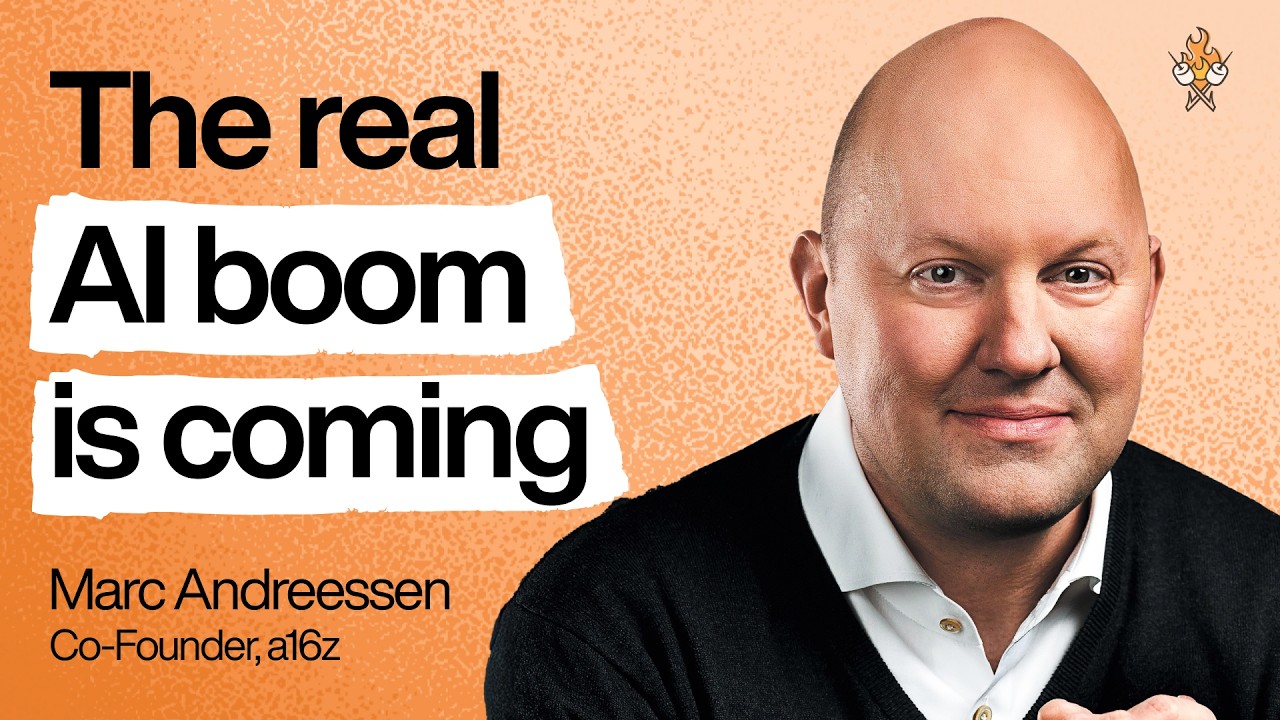
These notes are based on the YouTube video by None
Key Takeaways
- AI arrives at a historic inflection point – after five decades of sluggish productivity growth and a declining population, AI and robotics now appear just when they’re needed most.
- Human labour will become a premium resource because demographic decline and tighter immigration limits shrink the available workforce.
- Job loss is an oversimplified narrative; the real shift is task loss and the emergence of “super‑empowered” individuals who can combine multiple disciplines (coding, product, design).
- Education must pivot to one‑on‑one, AI‑augmented tutoring to give each learner the “philosopher’s stone” (AI) for rapid skill acceleration.
- Product managers, engineers, and designers are in a “Mexican standoff.” AI lets each role absorb the others, creating high‑value T‑shaped (or even “E/F‑shaped”) professionals.
- Economic impact: AI‑driven productivity spikes are expected to lift growth, put downward pressure on many prices, and free fiscal space for an expanded social safety net rather than cause mass unemployment.
- Investment outlook: a broad, indeterminate‑optimist approach (many bets, many founders) is preferred over trying to predict specific moats or winners.
- AGI definitions:
- Cosmic – a singularity in which AI self‑improves beyond human control.
- Prosaic – AI can perform the majority of economically valuable tasks at human‑level or better.
- Media & product diet: focus on real‑time sources (news, newsletters, podcasts) and timeless classics; leverage AI‑driven tools (Replit, Whisperflow, voice assistants) for both work and learning.
Detailed Explanations
1. Why the Timing Is Critical
- Historical productivity slowdown
- U.S. non‑farm business sector total‑factor productivity (the Solow residual) grew at roughly 2.8 % / yr from the late 1940s through the early 1970s, fell to ≈1.5 % / yr after 1974, and has hovered around 1 % / yr in the 2010s‑2020s. In other words, recent growth is about ½ the rate of the 1940‑1970 boom and ≈⅓ the rate of the 1870‑1940 era. (Bureau of Labor Statistics, TFP series.)
- Demographic collapse
- Fertility rates in most advanced economies sit well below replacement (≈2.1 children per woman). The EU averages ~1.5, the United States ~1.6, Japan ~1.3, and South Korea ~0.8 (2023‑2025 data).
- Several large countries—most notably China—are projected by the United Nations to lose population over the next century (China could fall from ~1.4 bn today to ~0.8 bn by 2100) unless policy or migration patterns shift dramatically.
- AI as the counterbalance
- AI can act as a productivity catalyst (the “philosopher’s stone” that turns sand → thought).
- By substituting for missing labour, AI can help keep output growing even as the working‑age population contracts.
- Companies that have built AI‑native enterprise strategies are already seeing the benefits of this shift. See how Block is navigating this transition in the article “How Block is becoming the most AI‑native enterprise in the world”.
2. Jobs vs. Tasks
- Job = bundle of tasks.
- Task loss occurs when AI automates specific activities (e.g., code generation, icon design).
- Jobs persist until the entire bundle of tasks is automated; historically, that transition has taken decades (e.g., secretaries → email).
3. The “Super‑Empowered Individual”
- Additive skill effect
- Mastery in two domains creates more than double the value of a single‑skill specialist.
- Mastery in three domains creates more than triple the value.
- T‑shaped (or E/F‑shaped) professionals
- Deep expertise in one area (vertical bar).
- Broad competence in the other two (horizontal bar).
- Practical steps
- Use AI daily as a coach: ask it to teach, quiz, and critique.
- Observe the AI’s “thought process” (e.g., chain‑of‑thought reasoning) to learn underlying concepts.
4. Future of Product, Engineering, and Design Roles
| Role | Traditional focus | AI‑enabled expansion |
|---|---|---|
| Product Manager | Road‑mapping, stakeholder alignment | Can generate specs, run user research, prototype via AI |
| Engineer | Write code manually | Orchestrate multiple coding bots, debug AI‑generated code, understand low‑level systems |
| Designer | Visual & interaction design | Generate countless iterations, focus on higher‑level user‑experience questions |
- The Mexican standoff analogy: each role believes AI lets them subsume the others, and they’re all right—AI can perform core tasks of all three.
- The new valuable role: AI orchestrator who guides bots, validates output, and adds strategic insight. Learning how to make codebases agent‑ready is a practical first step for anyone eyeing this role. See the deep dive “Making Codebases Agent Ready – Eno Reyes, Factory AI”.
5. Education & AI‑Augmented Tutoring
- One‑on‑one tutoring is the most effective (Bloom’s “Two‑Sigma” effect: lifts a student from the 50th to the 99th percentile).
- AI makes scalable tutoring possible:
- Instant Q&A, adaptive explanations, “teach me” mode, quizzes, and feedback loops.
- Example workflow:
- Student asks a concept.
- AI explains, then asks the student to rephrase.
- AI quizzes, adjusts difficulty, and repeats.
- Homeschooling as a testbed: Marc’s 10‑year‑old uses Replit, Claude, ChatGPT, and Copilot for coding while still learning fundamentals.
🔗 See Also: Ship Production Software in Minutes, Not Months — Eno Reyes, Factory
💡 Related: The AI‑native startup: 5 products, 7‑figure revenue, 100% AI‑written code — Dan Shipper
6. Economic Scenarios
- Optimistic (productivity boom)
- Massive output with lower input → price deflation in many sectors, higher real wages, and more fiscal space for social programs.
- Realistic (incremental but significant)
- AI could triple effective productivity relative to today, pushing growth rates back toward those seen in the 1870‑1930 period and creating new jobs even as some tasks disappear.
7. Investment Thesis & Moats
- Indeterminate optimism (a16z’s stance):
- Fund many bright founders, each acting as a determinant optimist (clear, concrete mission).
- Venture capital’s role is to run many experiments rather than predict a single winner.
- Moats are still unknown:
- Base AI models commodify quickly (open‑source releases, rapid replication).
- Sustainable advantage is likely to arise from domain‑specific applications, data assets, and integration expertise rather than the raw model itself.
- For a concrete illustration of how an AI‑native startup can scale rapidly, see the case study “The AI‑native startup: 5 products, 7‑figure revenue, 100% AI‑written code”.
🔗 See Also: How Block is becoming the most AI‑native enterprise in the world
💡 Related: Making Codebases Agent Ready – Eno Reyes, Factory AI
8. AGI Perspectives
- Cosmic AGI: a singularity in which an AI self‑improves beyond human oversight, rendering human judgment largely irrelevant.
- Prosaic AGI: AI can perform the majority of high‑value economic tasks at or above human level.
- Current models already match or exceed human performance on many benchmark tasks (e.g., MMLU scores in the 85‑95 % range). The analogy to an IQ of 130‑160 is a useful illustration but not a rigorous measurement—AI “IQ” remains a metaphor, not a standardized test.
9. Media & Product Consumption
-
Media strategy
- Barbell approach: mix real‑time sources (newsletters, podcasts) with timeless works (classic books).
- Avoid “middle” content that quickly becomes outdated.
- Prioritize direct voices of practitioners (substack newsletters, podcasts).
-
Product favorites
- Replit – an AI‑enhanced coding playground, especially kid‑friendly.
- Whisperflow – a voice‑to‑text platform that adds interactive AI capabilities.
- AI voice assistants (e.g., xAI’s Grok “Bad Rudy” persona).
- Wearables & voice‑input hardware – an emerging growth area.
- For a quick look at how teams can ship production software in minutes using AI, check “Ship Production Software in Minutes, Not Months”.
Summary
Marc Andreessen argues that we are at a uniquely advantageous moment: decades of stagnant productivity and falling population are meeting a breakthrough in AI and robotics. Rather than fearing massive job loss, the focus should be on task transformation and the rise of “super‑empowered” individuals who blend coding, product, and design skills using AI as a catalyst. Education must shift to AI‑augmented, one‑on‑one tutoring to give each learner the tools to accelerate their abilities.
Economically, AI‑driven productivity is expected to boost growth, put downward pressure on many prices, and make human labour more valuable, especially as the workforce shrinks. For investors, the safest bet is a broad, indeterminate‑optimist strategy that funds many determined founders, acknowledging that true moats and market structures are still unfolding.
Finally, staying informed requires a mix of up‑to‑date feeds and timeless literature, while leveraging AI‑centric tools (Replit, Whisperflow, voice assistants) to both work and learn more efficiently.