# Making Codebases Agent Ready – Eno Reyes, Factory AI
Table of Contents
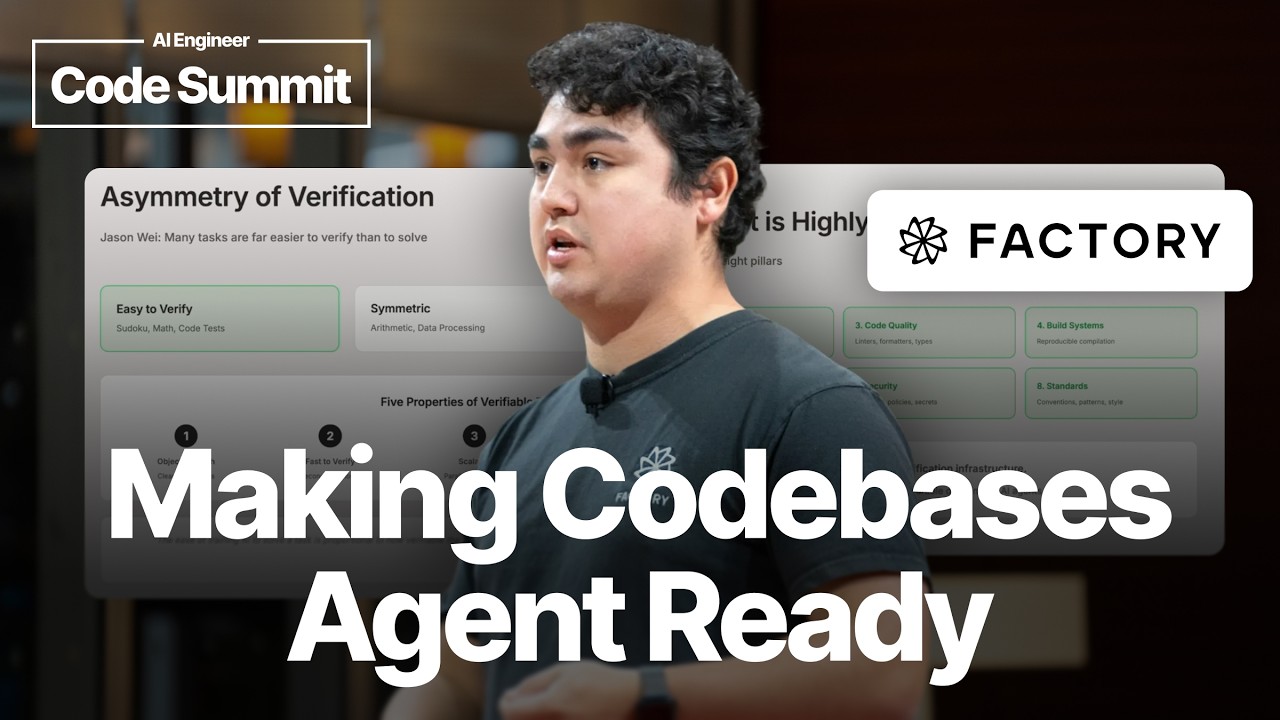
These notes are based on the YouTube video by AI Engineer
Key Takeaways
-
Agents thrive on verification, not just model quality.
- The bottleneck for reliable AI‑driven development is the environment—its validation mechanisms, explicit constraints, and predictability.
-
Software development is inherently highly verifiable.
- Decades of tooling (unit tests, linters, CI, API specs) give agents a fertile ground to operate if those tools are used rigorously.
-
Continuous, opinionated validation is essential.
- Generic linters or flaky test suites are insufficient; validation must be predictable and aligned with the quality level of senior engineers.
-
Shift from “specification‑first” to “specification‑driven” development.
- Instead of writing code first and then testing, define constraints and validation criteria up front, let the agent generate solutions, then verify automatically.
-
Invest in the organization, not just the tool.
- Spending weeks evaluating every AI coding tool yields far less ROI than strengthening the eight pillars of automated validation across the codebase. Engineers who adopt the top agentic engineers techniques see dramatically faster iteration cycles.
-
A virtuous DevEx feedback loop:
- Better validation → better agent performance → faster improvements to validation → exponential gains in engineering velocity.
-
Real‑world impact:
- Companies that embed strong validation can see substantial productivity improvements—benchmarks such as SWE‑bench suggest multi‑fold gains, and many early adopters report 2‑5× increases—while organizations with weaker validation often see more modest 1.5‑2× lifts.
Detailed Explanations
1. Verification vs. Specification
- Traditional software is built by specifying an algorithm: “Given X, produce Y.”
- AI‑enabled automation works better when the problem is framed as verification: “Is the output correct?”
- Why it matters:
- Verification tasks are often easy to automate (e.g., unit tests, linting).
- They provide a clear, objective signal that agents can use to iterate rapidly.
2. The Asymmetry of Verification
-
Borrowed from the P vs NP discussion, many problems are easy to verify but hard to solve.
-
In software:
- Easy to verify: Does the code compile? Does a test pass? Does the API contract hold?
- Hard to solve: Writing the correct implementation from scratch.
-
Agents excel when the verification side is strong; they can search the solution space efficiently if they can quickly check each candidate.
3. Automated Validation – The Current Landscape
| Validation Layer | Typical Tooling | Agent‑Readiness Rating* |
|---|---|---|
| Syntax / Formatting | prettier, black | High (easy to enforce) |
| Static Analysis / Linters | eslint, pylint (opinionated configs) | Medium‑High (needs strict rules) |
| Unit / Integration Tests | Jest, pytest, JUnit | Medium (coverage often 50‑60 %) |
| End‑to‑End (E2E) Tests | Cypress, Playwright | Low‑Medium (flaky builds common) |
| API Specs / Docs | OpenAPI, Swagger | Medium (auto‑generated docs help) |
| Continuous Integration (CI) Pipelines | GitHub Actions, Jenkins | High (gatekeeper for PRs) |
| Runtime Monitoring | Sentry, Datadog | Low (post‑deploy, not pre‑merge) |
| Security / Dependency Scanning | Dependabot, Snyk | Medium (often optional) |
*Ratings are indicative of typical industry experience; individual organizations may score higher or lower depending on how opinionated and reliable their configurations are.
- Observation: Most organizations have some of these layers, but they are rarely opinionated enough for agents to rely on them automatically.
4. Specification‑Driven Development Flow
- Define Constraints – Explicitly state the required linters, test thresholds, API contracts, etc.
- Prompt the Agent – Provide a high‑level goal plus the validation criteria.
- Generate Solution – Agent writes code, docs, tests, etc.
- Automated Verification – CI runs the defined validators; failures are fed back to the agent.
- Iterate – Agent refines the output until all validators pass.
- This loop mirrors classic “design‑code‑test” but front‑loads verification, making the agent’s search space tractable.
5. The Eight Pillars of Automated Validation
“You can go and analyze where you are across those eight different pillars of automated validation.”
- Linters (style & static analysis)
- Code Formatting
- Unit Test Coverage
- Integration / E2E Test Reliability
- API Specification (OpenAPI, GraphQL schema)
- CI/CD Gatekeeping
- Runtime Observability (metrics, logs, alerts)
- Security & Dependency Audits
- Actionable step: Conduct a quick audit—rate each pillar on a 0‑5 scale, then prioritize improvements that will give agents the most deterministic feedback.
🔗 See Also: The 5 Techniques Separating Top Agentic Engineers Right Now
6. The Role of Engineers Shifts
- From “code writers” → “environment curators.”
- Engineers now spend time defining constraints, building opinionated validators, and maintaining the feedback loop.
- This shift preserves human expertise while allowing agents to handle the repetitive, deterministic parts of development.
7. Practical Recommendations
| Recommendation | Why It Matters |
|---|---|
| Make linters opinionated (e.g., enforce naming, complexity limits) | Guarantees agents produce code that meets senior‑engineer standards. |
| Adopt “slop tests” (minimal tests that catch obvious regressions) | Even low‑quality tests give agents a signal; they can be refined over time. |
Create agents.md – a shared spec file describing required validation steps for agents | Provides a single source of truth that any coding agent can read. |
| Track validation coverage per developer (e.g., junior vs senior) | Reveals hidden gaps that prevent certain teams from benefitting from agents. |
| Iterate on CI pipelines to fail fast on missing env vars or undocumented dependencies | Reduces “tribal knowledge” failures that commonly break agents in production. |
| Invest in a DevEx feedback loop – allocate time each sprint to improve validators | Amplifies the productivity gains of any AI tool you adopt. |
| Leverage specialized Claude Code MCP servers for heavy‑weight generation tasks | The right infrastructure, as outlined in Claude Code MCP servers, reduces latency and improves reliability. |
8. ROI Perspective
- Tool‑centric approach:
- Cost: weeks of evaluation, marginal gains (≈ 10 % accuracy improvement).
- Environment‑centric approach:
- Cost: focused effort on the eight pillars (often achievable in a few sprints).
- Benefit: enables parallel agent execution, decomposition of large modernization projects, and reliable autonomous PR merges.
💡 Related: Ship Production Software in Minutes, Not Months — Eno Reyes, Factory
Bottom line: Strengthening the environment yields multiplicative returns across all AI‑assisted tools, not just a single product.
Summary
AI coding agents are poised to transform software engineering, but their success hinges on how ready the codebase environment is. Verification‑heavy workflows—rigorous linters, high‑coverage tests, explicit API specs, and robust CI—provide the deterministic feedback loops agents need to operate reliably at scale.
Organizations should pivot from exhaustive tool comparisons to systematically upgrading their automated validation across the eight pillars. By doing so, they unlock a virtuous cycle: better validation → stronger agent performance → faster improvements to validation, delivering substantial productivity gains (often 2‑5× in practice).
Investing now in opinionated, continuous validation is the most strategic move for any engineering leader aiming to stay ahead in the AI‑augmented development era.
🔗 See Also: Outperform 99% Of Vibe Coders With This Planning Method