# How to Show Up in ChatGPT: HubSpot's Winning AEO Playbook | GROW EUROPE 2025 | HubSpot Live
Tom Brewer
Table of Contents
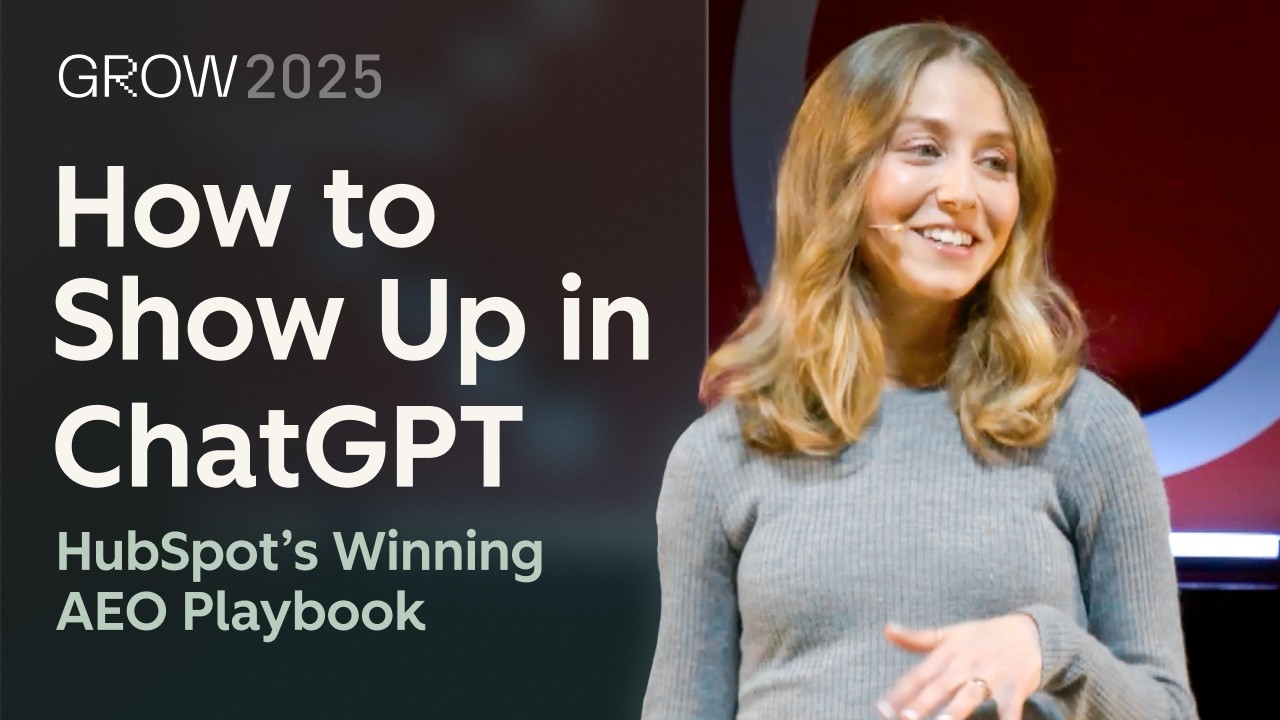
These notes are based on the YouTube video by HubSpot Live
Key Takeaways
- Answer Engine Optimization (AEO) is an emerging key demand‑generation channel; it’s expected to play an increasingly large role as AI‑driven answer engines grow, and many experts project that by 2028 a substantial share of answer‑engine traffic will originate from ChatGPT‑style LLMs. For a deeper dive, see our overview of Answer Engine Optimization (AEO) and how to get your brand found in AI search.
- Human‑first, hyper‑specific content outperforms broad “ultimate guide” assets for AI visibility.
- AEO lives in the Amplify stage of HubSpot’s Loop Marketing Framework and requires a mix of content, technical, and off‑site tactics.
- Query fan‑out and personalized memory are core AI behaviors that dictate how answers are synthesized.
- Success is measured by AI visibility, AI share of voice, AI citations, and AI referral demand—not just traditional SEO rankings.
Important Concepts
1. Answer Engines & Query Fan‑Out
- When a user asks a question, the engine often breaks it into multiple sub‑questions (fan‑out) and gathers answers for each before synthesizing a single response.
- Example: “Best place to go after Grow” → sub‑queries about bars, late‑night food, casual meet‑ups, price limits, etc.
2. Memory & Personalization
- LLMs incorporate a user’s past interactions (search history, clicks, connected apps, emails, etc.) to tailor each answer.
- This makes AI‑generated results highly personalized, raising the bar for relevance and authority.
3. Loop Marketing Framework – Amplify Stage
- The Amplify stage is where AEO tactics live, focusing on expanding brand visibility beyond owned channels into answer‑engine recommendations.
AEO Content Strategy
1. Shift from Broad Guides to Laser‑Focused Answers
- Replace “ultimate guide” pieces with content that directly answers a single buyer question.
- Aim for 10 focused assets for every 1 broad guide.
- When building those assets, follow the proven steps in our How to Build a Page AI Will Love (AEO Checklist) to ensure each page is AI‑ready.
2. Persona‑Stage Grid (3 × 4 matrix)
| Persona | Awareness | Consideration | Evaluation | Decision |
|---|---|---|---|---|
| Marketing Manager – 200‑person logistics firm | “How do I generate leads without a budget?” | “Top tools for lead scoring” | “HubSpot vs. competitor X for lead scoring” | “Can HubSpot automate lead scoring for my team?” |
| Sales Ops Director – SaaS | … | … | … | … |
- How to build:
- List specific buyer personas (include industry, company size, role).
- Add the four funnel stages down the left side.
- Populate each cell with the exact question the persona asks at that stage.
3. Sources for Question Discovery
| Method | What it Gives You | Tips |
|---|---|---|
| Keyword tools (Ahrefs, SEMrush, Search Console) | Volume‑based proxy for interest | Use as baseline when AI query data isn’t available |
| Social listening (Meltwater, Common Room) | Real‑world question phrasing from Reddit, Quora, YouTube, Instagram | Capture natural language |
| CRM & sales transcripts | Highest‑intent, product‑specific queries | Interview reps if transcripts are missing |
- Tag, sort, and map each question to the funnel stage. A simple spreadsheet or a HubSpot Project can serve as the repository.
Technical Checklist for AEO Pages
| # | Checklist Item | Why It Matters |
|---|---|---|
| 1 | Answer first – place the full answer in the opening sentence | AI looks for a concise, direct answer to validate relevance |
| 2 | Expand in 2‑3 short paragraphs – provide context, definitions, methodology | Signals depth and credibility |
| 3 | Reference original data – stats, case studies, CRM insights | AI favors novel, citable information. See our ultimate guide to AEO: How to get ChatGPT to recommend your product for examples of data‑rich citations. |
| 4 | Add an FAQ section – 3+ sub‑questions, each with its own H3/H4 heading | Captures fan‑out queries in one page |
| 5 | Use rich structure – bullet lists, tables, explicit headers | Makes the content “lazy‑reader” friendly for AI |
| 6 | Chunkable sections – each paragraph should stand alone | AI reads passages (“chunking”) independently |
| 7 | Tie every point back to the product – embed product relevance in each paragraph | Reinforces why the answer points to your brand |
Tip: Run a quick “Taco Bell test” – can each section be understood without the surrounding text? If not, rewrite for independence.
Off‑Site Authority & Mentions
- Mentions > Backlinks – Answer engines prioritize brand mentions (e.g., Reddit, LinkedIn, review sites) over traditional hyperlink authority.
- Target high‑impact sources – Use tools like XFunnel to find answer‑engine‑cited articles where your brand is absent. Prioritize outreach to those publications.
- Message‑rich mentions – Ensure any mention includes product‑specific language that aligns with your positioning; hyperlinks are optional.
- Leverage UGC platforms – Boost presence on G2, Capterra, TrustRadius with feature‑specific reviews; AI often pulls directly from these sources.
- Human‑first channel seeding – Partner with YouTubers, newsletters, LinkedIn thought leaders to embed your product in context‑rich content that AI later trains on.
🔗 See Also: Pieter Levels’ Genius Programmatic SEO Strategy Explained
Measuring AEO Success
| Metric | Description | How to Track |
|---|---|---|
| AI Visibility | Whether your brand appears in answer‑engine responses for target queries | Use HubSpot AEO Grader (free) or XFunnel |
| AI Share of Voice | Portion of AI‑generated recommendations that name your brand vs. competitors | Compare visibility counts across engines |
| AI Citations | Frequency your content is quoted as a source in AI answers | XFunnel citation reports |
| AI Referral Demand | Visits, leads, and sales originating from AI interactions | Add a checkout survey question “How did you hear about us?”; track via HubSpot’s AI Referral source type |
- North Star: AI Visibility – drives downstream conversion.
- Complementary: AI Share of Voice helps interpret platform‑wide shifts (e.g., a dip in overall visibility may be platform‑wide, not a brand issue).
💡 Related: What Is AEO? How to Get Your Brand Found in AI Search | Field Notes
Summary
- The rise of answer engines like ChatGPT is reshaping demand generation; traditional SEO alone won’t cut it.
- HubSpot’s AEO framework combines hyper‑specific, persona‑stage content, AI‑friendly technical structure, and mention‑focused off‑site authority.
- Building a persona‑stage grid, mining questions from multiple sources, and following a strict page checklist are the tactical foundations.
- Off‑site work shifts from backlinks to brand mentions with product‑aligned messaging and UGC amplification.
- Success is measured with a new AI‑centric scorecard: visibility, share of voice, citations, and referral demand.
By adopting these practices now, marketers can position their brands to capture a growing share of answer‑engine traffic in the years ahead, turning AI‑driven buyers into high‑value customers.