# How Block is becoming the most AI-native enterprise in the world | Dhanji R. Prasanna
Table of Contents
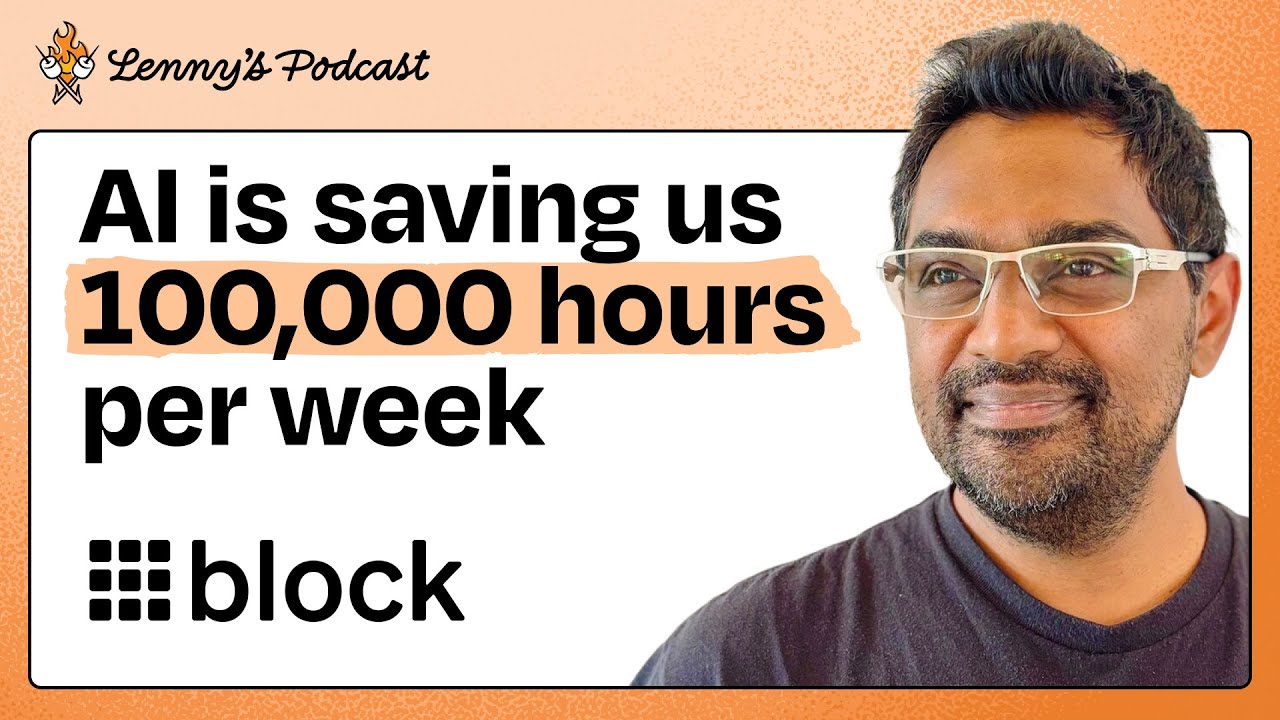
These notes are based on the YouTube video by Lenny’s Podcast
Key Takeaways
-
AI‑first culture can be catalyzed by a single “AI manifesto.”
Dhanji’s short letter to Jack Dorsey sparked Block’s shift toward becoming an AI‑native enterprise. (See how an AI‑native startup built 5 products and hit 7‑figure revenue.) -
Organizational structure matters more than tools.
Moving from a GM‑centric model to a functional, technology‑first org (single heads of Engineering, Design, etc.) unlocked the ability to ship AI‑driven productivity gains at scale. -
Goose – Block’s open‑source AI agent – delivers measurable time savings.
- Average 8‑10 hours saved per employee per week (≈ 20‑25 % of manual work).
- Benefits span engineers and non‑technical teams (risk, legal, product, etc.).
- Learn more about the power of AI code agents in the Claude Code Agents guide.
-
AI productivity is a moving baseline.
The current “worst‑case” numbers are already the baseline; value will increase as models improve and adoption deepens. -
The biggest impact comes from people who embrace AI, not from seniority alone.
Both junior engineers (who can “blitz” through tasks) and senior engineers (who can orchestrate complex workflows) see gains, but the surprising star performers are non‑technical staff using agents to build tools themselves. -
Open‑source and open protocols accelerate adoption.
Goose is built on the Model Context Protocol (MCP), an extensible wrapper that lets LLMs invoke real‑world tools (SQL, Salesforce, OS APIs, etc.). Open‑source tooling can shrink delivery cycles dramatically, as shown in the “Ship Production Software in Minutes, Not Months” case study (read it here). -
Productivity myths debunked:
- Code quality is not a predictor of product success.
- “Rewrite everything” can be viable when AI can rebuild from scratch overnight.
-
Hiring focus shifts from “AI expertise” to a learning mindset and willingness to experiment with AI tools.
Detailed Explanations
🔗 See Also: The AI-native startup: 5 products, 7‑figure revenue, 100% AI‑written code.
1. The AI Manifesto
- What it was: A concise internal memo urging Block to become an AI‑native company and to centralize AI efforts.
- Impact: Prompted weekly executive meetings, added Dhanji to the core group, and led to his promotion to CTO.
- Lesson: A clear, bold vision—no matter how brief—can align leadership and unlock rapid change.
2. Organizational Realignment
| Before (GM Structure) | After (Functional Structure) |
|---|---|
| Separate engineering/design teams per product line (Square, Cash App, Afterpay, Tidal, etc.) | Single, company‑wide Engineering org, single Design org, unified platform teams |
| Decisions filtered through product CEOs | Direct technical leadership, shared standards, common tooling |
| Silos with divergent technical strategies | Unified technical language, shared policies, easy internal mobility |
- Why it mattered: Conway’s Law – “organizations design systems that mirror their communication structures.” By consolidating tech leadership, Block could enforce a coherent AI strategy, share tools like Goose, and avoid duplicated effort.
3. Goose – The General‑Purpose AI Agent
Core Architecture
- Model Context Protocol (MCP): Formal wrappers around existing tools (SQL, Salesforce, OS APIs, etc.) that expose them to LLMs.
- Pluggable model back‑ends: Supports Claude, OpenAI, or self‑hosted open‑source models via a provider system.
- Multi‑platform UI: Desktop Electron app (Mac/Windows/Linux) + CLI for power users.
Typical Workflow (illustrative)
User: “Goose, build a monthly marketing performance report and email it to the team.”Goose: 1. Calls MCP → Snowflake → generates SQL query. 2. Executes query, loads results into Pandas. 3. Uses a charting library (e.g., Chart.js) to create visualizations. 4. Writes a Python script to assemble a PDF via ReportLab. 5. Sends the PDF via Gmail API.-
Self‑service for non‑technical staff: Enterprise Risk Management built a full risk‑self‑service system in hours, bypassing a months‑long internal app request.
-
Mobile variant – “Gosling”: A prototype mobile‑focused variant has been explored that leverages Android’s accessibility API to automate UI interactions. While the concept has been demonstrated internally, it has not yet been publicly documented as a production feature.
Open‑Source & Extensibility
- Repo: Public GitHub (link provided in show notes).
- MCP ecosystem: Anyone can write a new MCP (e.g., for a proprietary CRM) with a few lines of code, instantly giving Goose the ability to act on that system.
4. Measuring AI Impact
- Primary metric: Manual hours saved – derived from self‑reported surveys plus quantitative data (PR throughput, feature velocity).
- Company‑wide estimate: ~20‑25 % of manual effort eliminated across all functions.
- Variability:
- Greenfield projects (new codebases) see the highest gains.
- Legacy, complex codebases still lag; AI assists but cannot fully replace deep refactoring.
5. Lessons on Product & Engineering
| Counter‑Intuitive Insight | Explanation |
|---|---|
| Code quality ≠ product success | Example: YouTube’s “messy” codebase still outperformed Google Video. The product’s ability to solve a user problem matters far more. |
| Rewrites can be strategic | With AI agents working overnight, rebuilding an app from scratch becomes feasible, allowing rapid experimentation. |
| Controlled chaos fuels innovation | Allow engineers autonomy to spin up “wasteful” experiments; the best ideas surface, while guardrails (reliability, security) keep the system stable. |
| Question base assumptions | Before building a tool, ask whether the process is needed at all. Often the answer is “no,” saving effort and complexity. |
6. Hiring & Talent Development
- Shift from “headcount as commodity” to “expertise as catalyst.”
- Desired traits: curiosity, willingness to adopt AI assistants, learning mindset.
- Interview evolution: Candidates may be asked to solve a problem using VibeCode/Goose rather than just write pseudocode.
7. Practical Tips for Teams Wanting to Go AI‑Native
💡 Related: Ship Production Software in Minutes, Not Months — Eno Reyes, Factory
- Use the tools yourself first. Leadership adoption (Jack, Dhanji) drives cultural acceptance.
- Start with a concrete, small problem. E.g., automate receipt aggregation from Google Docs – a task that shows immediate ROI.
- Leverage open protocols (MCP) to integrate existing internal tools.
- Measure impact early (hours saved, PR velocity) to build a data‑driven case for further investment.
- Encourage cross‑functional experimentation. Non‑engineers building apps with Goose can dramatically reduce engineering load.
Summary
Block’s transformation into an AI‑native enterprise hinged on three pillars: a bold internal manifesto, a functional, technology‑first organization, and the creation of Goose, an open‑source AI agent built on the Model Context Protocol. Goose has already saved employees 8‑10 hours per week, delivering a 20‑25 % reduction in manual effort across engineering and non‑technical teams.
The biggest productivity gains come from people who actively adopt AI tools—whether junior engineers blitzing through tasks or senior staff orchestrating complex workflows. The shift in hiring philosophy now favors a learning mindset over deep pre‑existing AI expertise.
Key cultural lessons include the power of Conway’s Law, the limited correlation between code quality and product success, and the strategic value of controlled chaos and rapid rewrites enabled by AI.
For any organization looking to emulate Block’s success, the roadmap is clear: articulate a compelling AI vision, align the org structure to support it, adopt extensible open‑source agents like Goose, and measure real‑world time savings. By doing so, teams can turn AI from a hype buzzword into a tangible productivity engine.