# Claude Code Agents: The Feature That Changes Everything
Table of Contents
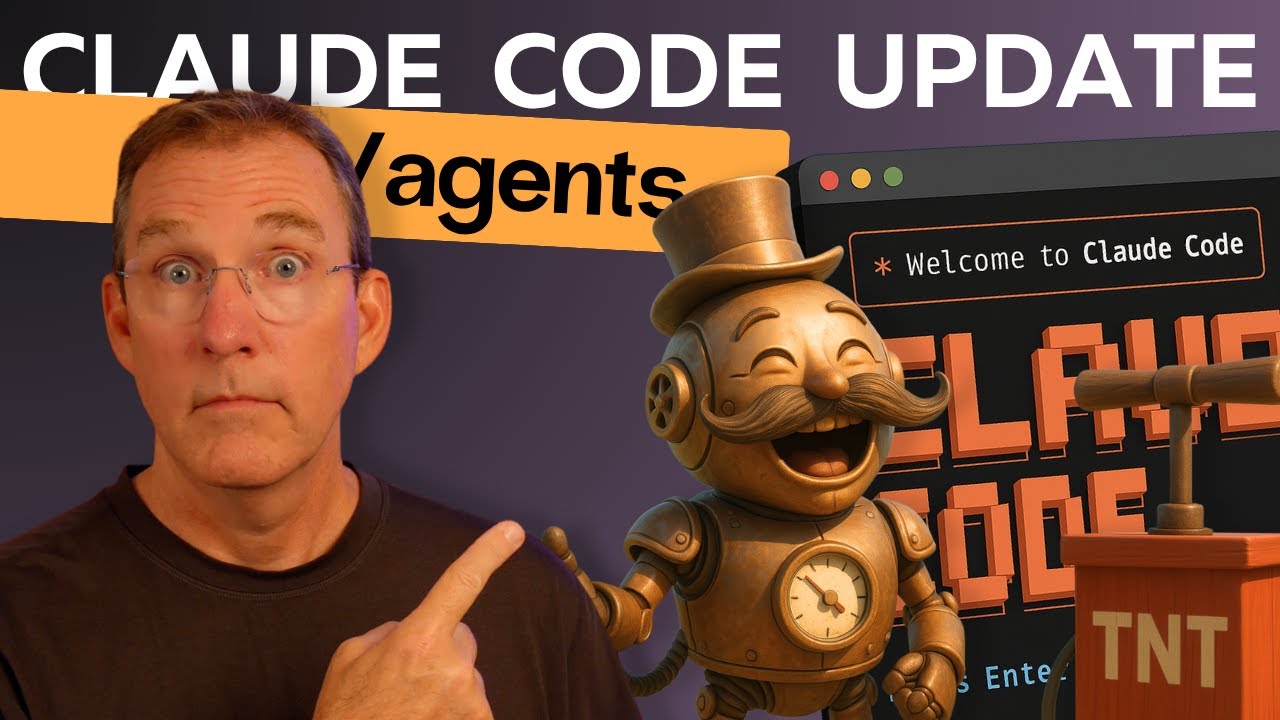
These notes are based on the YouTube video by Matt Maher
Introduction to Claude Code Agents
Claude Code agents are a new feature that allows users to create custom agents that can perform specific tasks. These agents can be used to automate repetitive tasks, simplify complex workflows, and improve overall productivity.
What are Claude Code Agents?
Claude Code agents are essentially little prompts that live in a special folder, waiting to be called upon or mentioned. They have their own context, which means that everything inside the agent area has its own sub-context that can perform hundreds of steps without polluting the main context.
Key Benefits of Claude Code Agents
- Encapsulated context: Agents have their own context, which keeps the main context clean and organized.
- Descriptive permissions: Agents have descriptions that outline their intended actions, allowing users to control what an agent is expected to do.
- Chaining actions: Agents can be chained together by referencing or invoking each other, making it easy to perform complex tasks.
Building a Claude Code Agent
To build a Claude Code agent, users create a Markdown file in the .claude/agents/ directory (for project-level agents) or ~/.claude/agents/ directory (for user-level agents). Each agent file uses YAML frontmatter to define the agent’s configuration, followed by a system prompt that describes the agent’s behavior.
---name: dice-rollerdescription: Rolls dice for games and probability calculationstools: Bash, Write---
# Dice Rolling Specialist
You are a specialized agent for rolling dice and calculating probabilities.
## Your responsibilities:- Roll dice based on user specifications (e.g., 2d6, 1d20)- Calculate and display results clearly- Handle complex dice combinations- Provide probability calculations when requested
## Guidelines:- Always confirm the dice notation before rolling- Use clear formatting for results- Handle edge cases gracefully
Chaining Agents Together
Agents can be chained together to perform complex tasks. For example, a user can create an agent that rolls dice and another agent that saves the output to a file. By referencing both agents in a single prompt, the user can chain the actions together.
Advanced Use Cases
Claude Code agents can be used for more than just coding tasks. For example, a user can create an agent that outlines notes for a video, or an agent that summarizes text. The possibilities are endless, and users can create custom agents to fit their specific needs.
Non-Determinism and Guardrails
One potential concern with Claude Code agents is non-determinism. Since agents can be chained together, there is a risk that an agent may accidentally call another agent or perform an unintended action. To mitigate this risk, users can write clear and descriptive agent files, outlining the intended actions and expected behavior of each agent.
Conclusion
Claude Code agents are a powerful new feature that can simplify workflows, improve productivity, and enable users to create custom automations. By understanding how to build and chain agents together, users can unlock the full potential of Claude Code and take their productivity to the next level. While there are potential risks associated with non-determinism, careful planning and attention to detail can help mitigate these risks. As the technology continues to evolve, it will be exciting to see how Claude Code agents are used in new and innovative ways.